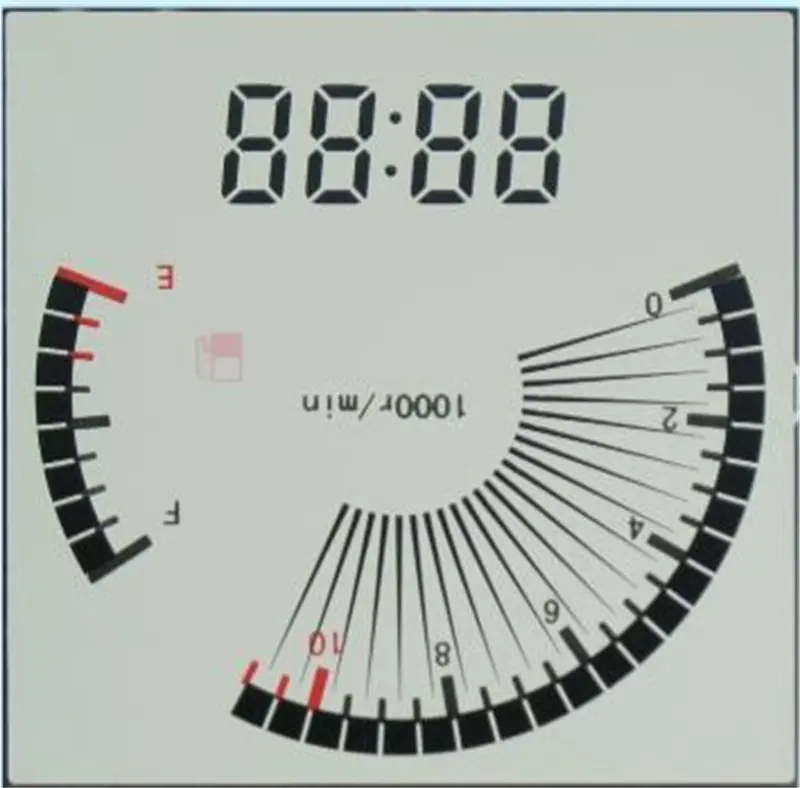
Liquid Crystal Display Module To trace the origin of liquid crystal displays, it is necessary to start with the birth of "liquid crystal". In 1888 AD, an Austrian botanist, Frederick. Friedrich Reinitzer discovered a special substance. He extracted a compound called helical toluate from plants. When doing heating experiments on this compound, he unexpectedly found that this compound has two melting points at different temperatures. And its state is between the liquid and solid substances we usually know, a bit like a colloidal solution of soapy water, but it has both liquid and crystal properties in a certain temperature range, and because of its unique Condition, later named it "Liquid Crystal", is the meaning of liquid crystalline substances. However, although the liquid crystal display module was discovered as early as 1888, it was only 80 years later that it was really useful for everyday products.
In 1968, at the Sanov R&D Center of RCA Corporation (a radio and television creation company) in the United States, engineers discovered that liquid crystal molecules would be affected by voltage, changing the arrangement of their molecules, and allowing the incoming light to deflection occurs. Using this principle, RCA company created the world's first screen using liquid crystal display. Since then, liquid crystal display technology has been widely used in general electronic products, such as calculators, electronic watches, mobile phone screens, instruments used in hospitals (because of radiation measurement considerations) or screens on digital cameras, etc. Interestingly, the discovery of liquid crystals was earlier than vacuum tubes or cathode ray tubes, but not many people in the world knew about this phenomenon. It was not until 1962 that the first book was written by Joe, a chemist from the RCA research group. Described in the book published by Mr. Joe Castellano. The same as the image tube, although these two technologies were created by the RCA company in the United States, they were carried forward by Sony and Sharp in Japan.
We also have Semi-transparent Liquid Crystal Display on sale, please contact us if you are interested.